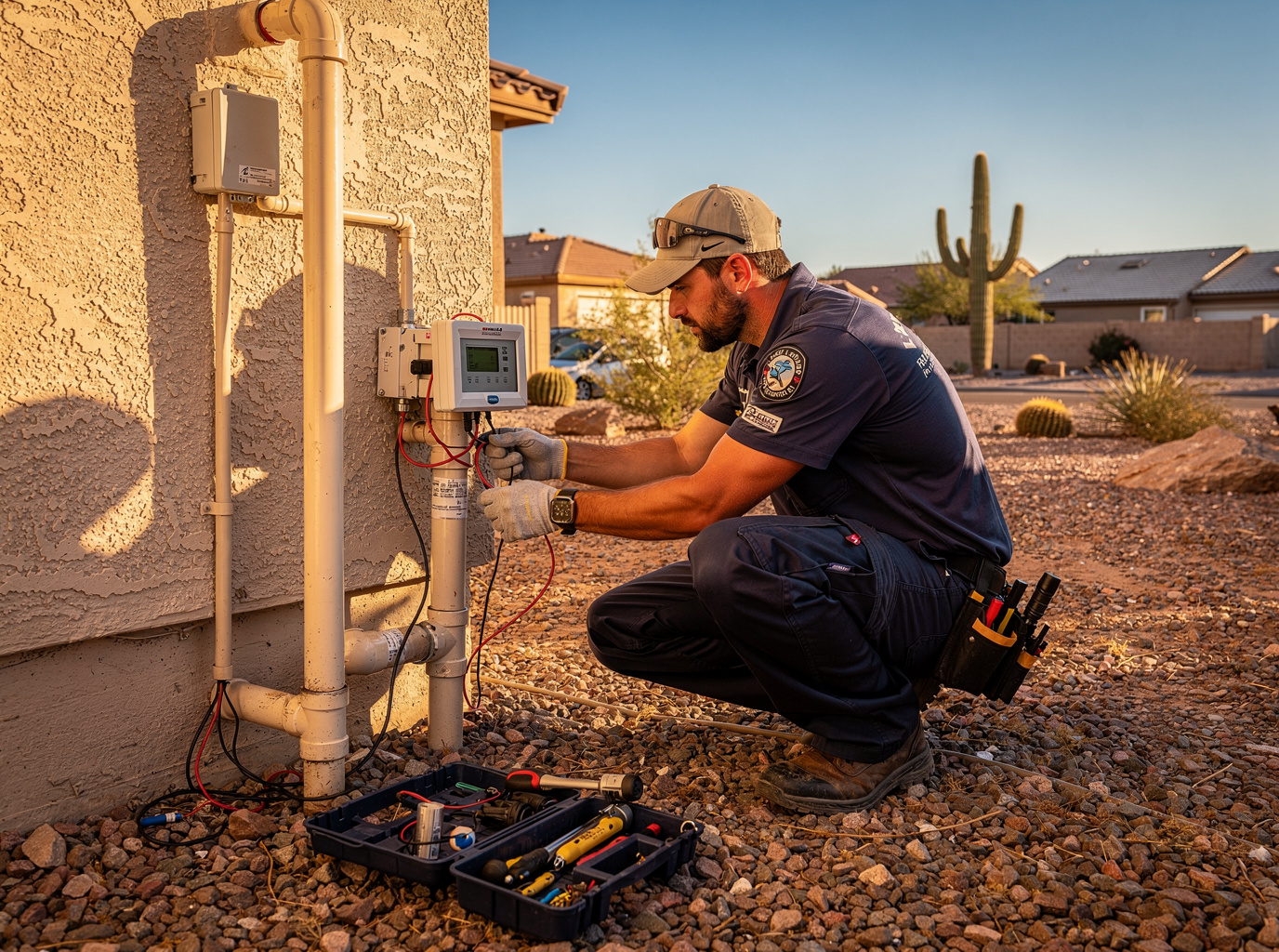
Tucson winters bring occasional hard freezes that can split valves and crack lines in older neighborhoods like those near 22nd Street and east side subdivisions. A freeze sensor shuts the system down before temperatures hit damaging levels, but placement matters because sensors mounted too close to heat-retaining stucco walls or in low pockets read inaccurately. We use commercial-grade sensors rated for Arizona's wide diurnal swings and wire them directly into the controller so the system never runs during a freeze event.
Soil in the Tucson basin drains quickly, which means lines can lose heat faster than in heavier soils, increasing the risk of burst pipe segments near the backflow preventer. Proper sensor installation accounts for this by siting the unit at the coldest point on the property, usually the north side of the house or an exposed valve box. We also check existing wiring for corrosion common in 20-plus-year-old homes before adding the new sensor.
Homeowners often confuse freeze sensors with rain sensors; the two serve different functions and cannot be swapped. A freeze sensor activates at 37 degrees and stays off until temperatures rise safely, while rain sensors only pause for moisture. We install units that integrate with both Hunter and Rain Bird controllers common in Tucson without voiding warranties on the existing timer.
Edge cases include multi-zone properties where one sensor cannot cover all exposures, requiring additional units or a wireless model that reports to a central receiver. We also verify that the sensor does not interfere with drip irrigation zones that run on separate schedules in desert landscaping.
Technician insight
In Arizona the thing that catches most people out with freeze sensor installation is mounting the sensor on the south side of the house where stucco holds daytime heat; on east Tucson lots from the 1980s this placement often keeps the sensor from triggering until after lines have already started to freeze.
East side home with split zones
A homeowner near 22nd Street reported one zone running during a cold snap while the rest shut off. We found the sensor had been placed against a south wall that retained heat. We relocated it to the north valve box, added a second sensor for the drip zone, and verified shutoff at 37 degrees.
Freeze Sensor Installation Services We Offer
✓Residential Freeze Sensor Installation
Installs a dedicated freeze sensor on single-family homes in Tucson neighborhoods to shut off irrigation before freezing temperatures damage valves and lines.
✓Wireless Freeze Sensor Upgrade
Replaces hard-wired sensors with wireless models that transmit to existing controllers, useful for homes with difficult trenching conditions around mature landscaping.
✓Freeze Sensor Calibration and Testing
Adjusts sensor thresholds and verifies activation at 37 degrees using local weather data for properties near the Catalina foothills where microclimates vary.
✓Multi-Zone Freeze Protection Setup
Adds sensors or receivers to cover separate irrigation zones on larger lots common in east Tucson, preventing partial system freeze damage.
✓Freeze Sensor Integration with Existing Controllers
Wires new sensors into Hunter, Rain Bird, or Toro timers already in place on older Tucson properties without replacing the entire control panel.
Freeze Sensor Installation Cost in Arizona, Tucson
| Service | Typical Range | What Affects It |
|---|---|---|
| Basic residential freeze sensor installation | $175–$275 | Single sensor on accessible controller; price rises with trenching needs. |
| Wireless sensor upgrade | $250–$375 | Includes receiver; higher when multiple zones require extra units. |
| Multi-zone freeze protection | $325–$475 | Two or more sensors; depends on property size and controller age. |
| Calibration and testing only | $95–$145 | Existing sensor adjustment on standard systems. |
Ranges are typical for Arizona, Tucson and confirmed with an exact written quote before any work starts.
How it works
- 1
Site Assessment
We walk the property at 7240 E 22nd St area addresses to locate the coldest valve boxes and note controller type and wiring condition.
- 2
Sensor Placement
Mount the sensor on the north exposure or lowest point where freeze risk is highest, away from heat sources like south-facing walls.
- 3
Wiring And Connection
Run new low-voltage wire or pair a wireless unit to the controller terminals, testing for proper shutoff at 37 degrees.
- 4
Final Verification
Simulate a freeze event and confirm the system pauses across all zones before leaving the site.
Pricing
Most Tucson residential freeze sensor jobs fall in the mid-hundreds depending on wiring access and number of zones.