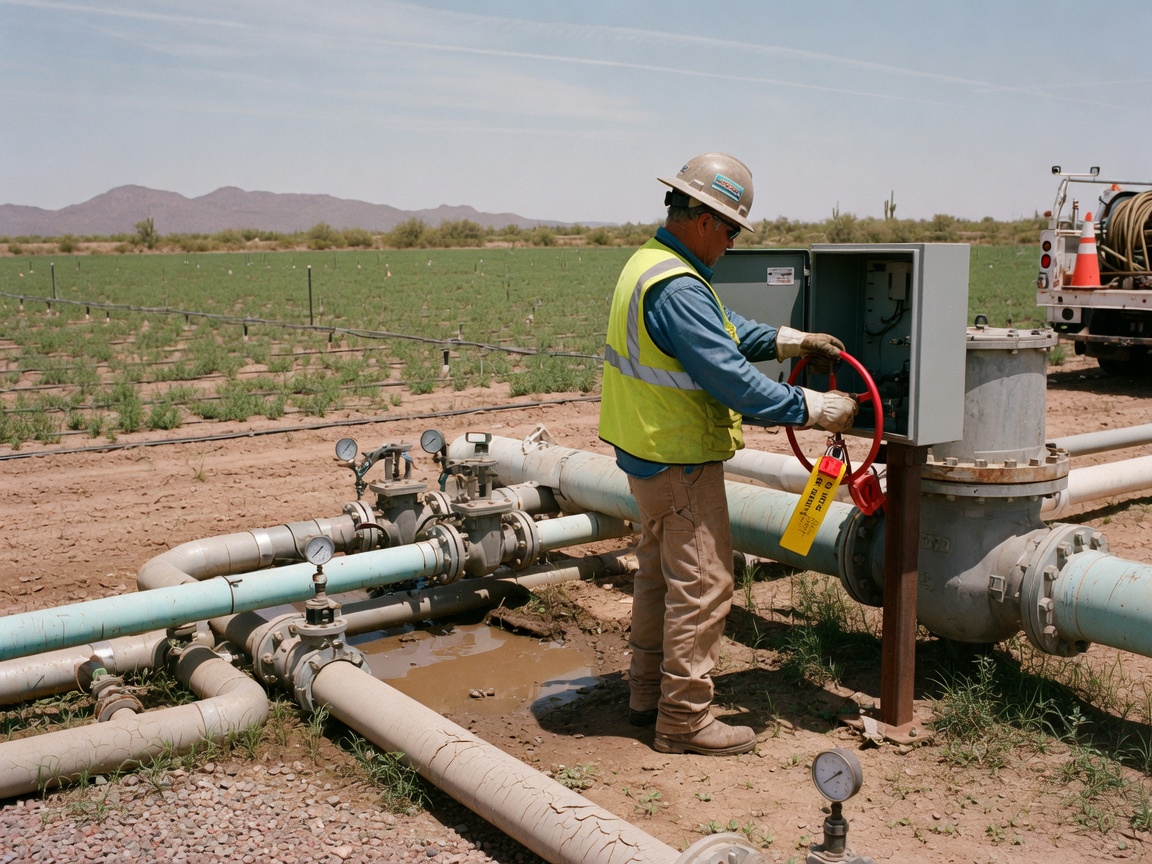
Tucson winters rarely reach hard freezes, yet overnight lows near the Catalina Foothills and East Side neighborhoods can still drop below 32 degrees, enough to split exposed PVC risers or crack backflow preventers. A proper shutdown uses compressed air at controlled pressure to clear every zone without forcing water back into the controller or damaging solenoid diaphragms common on 15- to 25-year-old homes along 22nd Street and Pantano Road. Skipping this step often leads to spring leaks once irrigation resumes after monsoon season saturates the caliche-heavy soil.
Hard water from the Central Arizona Project leaves mineral scale inside valves and swing joints throughout Tucson. During shutdown we isolate each manifold, relieve residual pressure, and tag any valves showing early corrosion so homeowners can schedule targeted repairs before summer heat returns. Rocky fill around newer subdivisions east of Kolb Road also shifts under heavy rain, so we inspect swing joints and flex tubing for movement that could create future stress cracks once the system is repressurized.
Older midtown properties built before 1995 frequently have galvanized or thin-wall poly pipe that cannot tolerate full 80-psi blowouts. We reduce pressure, cycle zones individually, and leave the backflow preventer in the open position so any remaining moisture can drain. This method prevents the cracked casings we see each spring when systems are turned back on without a prior shutdown.
Technician insight
In Arizona the thing that catches most people out with irrigation system shutdown is how monsoon runoff moves sandy fill around valve boxes on the East Side; a line that tested fine in July can crack by November if the swing joint shifted even an inch during the rains.
East Tucson Home Near 22nd Street
Homeowner reported a cracked riser the previous spring after an early cold snap. We found two valves in a washed-out box where monsoon water had eroded the trench. We performed a reduced-pressure blowout, replaced the damaged swing joints, and tagged every zone. The system stayed dry through winter and started cleanly in March.
Irrigation System Shutdown Services We Offer
✓Sprinkler Blowout Service
Compressed-air clearing of all zones to remove water before temperature drops reach freezing levels in East Tucson.
✓Backflow Preventer Winterization
Isolation and draining of the backflow assembly to protect the device from expansion damage during cold nights.
✓Zone Valve Shutdown and Tagging
Manual closure and labeling of each valve box so spring start-up crews know exactly which lines were cleared.
✓Controller Off-Season Programming
Setting the timer to rain mode or full bypass so the system does not attempt to run during the dormant months.
✓Post-Monsoon Line Inspection
Visual check for shifted swing joints or eroded trenches caused by heavy summer rains before shutdown begins.
Irrigation System Shutdown Cost in Arizona, Tucson
| Service | Typical Range | What Affects It |
|---|---|---|
| Standard 4–6 Zone Residential Blowout | $135–$225 | Most common price range for East Tucson tract homes |
| Larger 8+ Zone or Sloped Lot | $225–$325 | Extra time for rocky terrain and multiple manifolds |
| Backflow Preventer Service Add-On | $75–$125 | Includes drain-down and tag when done with shutdown |
| Same-Day Emergency Shutdown | $200–$300 | Available before hard freeze forecasts |
Ranges are typical for Arizona, Tucson and confirmed with an exact written quote before any work starts.
How it works
- 1
Site Walk and Zone Count
We map every valve box and note pipe material while walking the property to identify older poly lines common in midtown Tucson.
- 2
Pressure-Regulated Air Blowout
Air is introduced at reduced PSI, cycling one zone at a time until only mist exits each head.
- 3
Backflow and Drain-Down
The assembly is isolated and left open so any residual moisture drains before overnight lows arrive.
- 4
Documentation and Tagging
Valves are tagged and the homeowner receives a simple diagram for spring reactivation.
Pricing
Most Tucson residential irrigation shutdowns range from entry-level single-zone jobs to larger multi-valve properties; final cost depends on zone count, access, and pipe age.